University Anthem

The Fount
1.   Unibadan, fountainhead
     Of true learning, deep and sound
     Soothing spring for all who thirst
     Bounds of knowledge to advance
     Pledged to serve our cherished goals:
     Self-reliance, unity
     That our nation may with pride
     Help to build a world that is truly free.

2.   Unibadan, first and best,
     Raise true minds for a noble cause:
     Social justice, equal chances
     Greatness won with honest toil
     Guide our people this to know:
     Wisdom's best to service turned
     Help enshrine the right to learn
     For a mind that knows is a mind that's free.
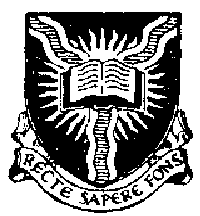
UNIVERSITY ARMS
Sable in front of a Sun in splendour Or, a Pall wavy Argent charged with another Azure over all in centre point; an open Book proper bound and edged Gules.
UNIVERSITY MOTTO
RECTE SAPERE FONS
(FOR KNOWLEDGE AND
SOUND JUDGEMENT)
History of the University
A BRIEF HISTORY OF THE UNIVERSI'IY
Since the latter half of the nineteenth ceniury, well-to-do Africans in Lagos had met the need for higher education by sending their children overseas for professional training. Some of these returned to press for the establishment of institutions of higher learning in Nigeria. Not much progress was made until the 1930s. In Nigeria, the Yaba Higher College (established in 1932 but formally opened in 1934) and the Yaba Medical School (established in 1930), which granted diplomas and certificates in selected subjects, hardly satisfied the aspirations of those who longed for university education.
The Yaba Higher College phase of education in Nigeria further illustrated the desire of Nigerians for degrees, diploma.s. and certifi-cates which were not interior to those awarded by universities in the United Kingdom and elsewhere. So long as British officials did not envisage self-government for Nigerians and senior posts in the public service were reserved for expatriates, pleas for university education in Nigeria fell on deaf ears.
The British Government seriously considered the possibility of establishing universities or university colleges in the Common-wealth, and in West Africa particularly, during World War 11. The Asquith and Elliot Commissions-both set up in 1943-reported on various aspects of this problem in 1945. The majority and minority reports of the Elliot Commission agreed on the establishment of a university college in Nigeria. The Asquith Commission concentrated on the fundamental principles which were to guide the development of institutions of higher learning similar to the University College subsequently established at f badan. The Asquith Commission emphasized the principles of a resi-dential university college in special relationship with London Uni-versity, high academic standards in admissions and staffing, and autonomy. Both the Elliot and Asquith Commissions, which exchanged information, agreed that the Inter-University Council for Higher Education in the Colonies (later Overseas) was to advise the new University Colleges on how best to attain the objectives for which they were established.
The University College, lbadan at first occupied the old site previously used by the 56th Military General Hospital about eight kilometres away from the 'new' or permanent site. The new site covered over 2,550 acres of land generously leased by the chiefs and people of lbadan for 999 years. With equipment transferred from Yaba Higher College, the 104 foundation students (including 49 students in teacher training and survey courses) began their courses at Ibadan on 18 January 1948; the formal opening took place on 25 March 1948. In February 1948, London University allowed lbadan its special relationship scheme. Arthur Creech Jones, then Secretary of State for the Colonies, and an influential member of the Elliot Commission, cut the first sod at the perma-nent site on University College, lbadan's first Foundation Day -17 November 1948.
For the foundation medical students, the facilities provided in 1948 by the Native Administration Hospital at Adeoyo and the Government Jericho Hospital, for which the Faculty of Medicine was responsible, were inadequate. To provide more satisfactory clinical facilities at lbadan, the Nigerian government made avail-able funds for the building of the 500-bed University Teaching Hospital completed in 1957. Thereafter medical students were fully trained in lbadan, the first batch graduating in 1960.
With the expansion of facilities at lbadan the number of students offered admission increased. In the 1958-59 session, UCI for the first time had a little over 1,000 students; in 1963-64 the figure exceeded 2,000; and tipped the 3,000-mark in 1968-69. The figure for 1972-73 was 4,110. The figures for 1974-75 and 1975-76 were 5,639 and 7,375 respectively. Some of these students include those resident at the Jos Campus which began with an enrolment of 101 in the 1971-72 session. In the 1973-74 session, the Jos Campus had 326 students, most of whom were prepared for courses in the Faculty of Arts. In the 1975-76 session, the number of students at Jos increased to 550. On 25 September 1975, however, the Govern-ment announced the creation of a University of Jos, and in conse-quence arrangements were made to transfer second year students there to lbadan and to hand over the campus at the end of the 1975-76 session. The Government also announced the setting up of a new University College at Ilorin, to be affiliated to the Univer-sity of lbadan.
Larger admissions over the years and limited funds for providing accommodation gradually threatened the concept of a residential, University at lbadan. The Jos Campus, when established, interested itself in experimenting with off-campus accommodation. From the 1972-73 session students at the Ibadan Campus have also been allowed to live off-campus in larger numbers. The existing halls of residence at the lbadan campus have been over-stretched in meeting the accommodation needs of students. Married students are encouraged to live off-campus. The eight undergraduate halls of residence (Mellanby, Tedder, Kuti, Sultan Bello, Queen Elizabeth 11, Alexander Brown, Independence, Nnamdi Azikiwe) and the one postgraduate hall of residence (Tafawa Balewa) have a total capacity of about 5,500 students. The older and new halls of residence are different in their designs. The older halls-Mellariby, Tedder, Kuti, Sultan Bello and Queen Elizabeth 11-were designed by the U.K. based firm of Maxwell Fry and Jane Drew. Alexander Brown Hall-for clinical students-was designed by the firm of Messrs Watkins Gray and Partners. The two larger and later built halls-Independence and Nnamdi Azikiwe-were the handiwork of the Design Group Ltd., while Tafawa Balewa Hall and the new extension to Queen Elizabeth Hall were designed by Messrs Aderele, Ornisore, Adebanjo Associates.
In addition, the University has provided accommodation for its senior, intermediate and junior staff. The Abadina complex caters for the residential needs of the bulk of junior and intermediate staff. In May 1976, there were 496 senior staff houses, chalets or flats on campus and these included the new houses near the Univer-sity Fish Pond. There are also the University Guest Houses, the Pro-Chancell or's Lodge and other buildings. The University also rented 221 quarters for senior staff living off-campus. The accom-modation and maintenance problems of the University increased as the numbers of junior, intermediate and senior staff rose. In 1959 ' 'there were about 530junior and intermediate staff. In February 1973 their number had risen to 4,197. In 1958, there were only 44 Nigerian senior staff (Academic, Library, Adn-dnistrative and Technical) as against 136 expatriates. But on I February 1973, the University had 117 senior administrative and technical officers, technician s/techn ologi sts as well as school teachers in the Inter-national School (Secondary) and Staff School (Kindergarten and primary). Of these, 95 per cent were Nigerians. These excluded a total of 566 academic staff of whom 416 were Nigerians and 150 expatriates. On I March 1975, the University hod a total of 694 academic staff (including the Library and the lbadan University Pres~,) as against an establishment of 893 for the 1974-75 session. At the same time, the University had a total of 236 administrative, professional and technical staff although the established figure for the 1974-75 session was 259. In July 1974, there were 5,637 Junior and 307 Intermediate staff. With steady Nigerianization, in the wake of a similar exercise from the 1950s in the public services of the federation, more and more Nigerians took up appointments in the University. But in general, the University has continued to maintain its historical complexion as an international community of scholars, students and other workers.
Staff salaries and other recurrent expenditure besides capital works made the University College (later University) an expensive establishment. While the British Government, the Cocoa Marketing Board, the Nuffield Foundation, the United Africa Company, and other interested bodies inside and outside Nigeria made gene-rous contributions towards the funding of capital projects, the brunt of the recurrent expenditure fell on the Nigerian govern-ment whose subvention rose from N200,000 in 1949-50 to N7,464,000 in 1971-72. The Federal Government's recurrent grant for 1972-73 was N10,226,000 and for 1973-74 was N11,036,000. The figure for the 1975-76 session was N23,171,000 for the Ibadan and Jos campuses. With inadequate public response to its appeal for an Endowment Fund in the 1950s, the University College relied heavily on government financial aid. From 1952, the government set its financial relations with the Universlt~ College on a quin-quennial basis. In the event, the national crisis in the 1960s dis-turbed such quinquennial arrangements in favour of ad hoc grants.
Financial grants also came from the American Foundations, notably Ford and Rockefeller which together contributed N7,717,592 to lbadan's development in the 1962-67 quinquennium. Such outside grants have in many ways assisted the academic development of the University, particblarly in postgraduate studies and staff development.
The University College in 1948-49 had three faculties (Arts, Science and Medicine). Today, there are eight faculties: Arts, Science, Medicine, Agriculture and Forestry, Social Sciences, Education, Veterinary Medicine, and Technology. The academic wings of the University include the Library, Institute of African Studies, the Institute of Chi)d Health, the Computing Centre, the Universiq Press, the lbarapa Community Health Project, and the Behavioural Sciences Research Unit. The Nigerian Institute of Social and Economic Research (NISER), financed by the Federal Government, maintains a special link with this University whose Council appoints its staff on terms of service similar to those enjoyed by staff of this University.
The Academic Board set up under the University College Ordi-nance (No. 25 of 1948) gave way to Senate under a new law in 1954. Under that Ordinance (No. 10 of 1954) a re-organized Council was also established. The membership of Council charged triennially. With academic indeperdence, the University had a new Act in 1962 which with subsequent amendinents in 1972 has remained the basic Constitution. That Constitution also provides for Congregation, Convocation, and such officers as the Visitor, Chancellor, Pro-Chancellor, Vice-Chancellor, Registrar, Bursar, Librarian, and Chief Engineer.
Though financially dependent upon Government and other organizations, and though constitutionally tied to the Federal Government through the Head of State (also the Visitor), this ~Jnivers;ty from its colonial origins has been trying to safeguard its autonomy in teaching and research. The special relationship scheme with London University did not prevent the College from adapting its syllabuses to suit local needs wherever possible. Several changes were in fact made in the degree structure as the need arose. Although the College began with general and honours /special degree courses in selected disciplines, these were re-examined from 1962 when the College gained its academic independence. From 1963 general degree courses gave way to hGnours special degrees. To introduce a greater element of flexibility into the tea-ching and examination programmes, the Faculty of Science began in 1969 the Course System which, with the exception of the Faculty of Medicine, was generally applied in the 1972-73 session. The various faculties engaged in the Course System are continuing to deal with the operational problems arising from the Course System especially in such areas as decentralized control and the need for increased staffing to tackle a variety of academic and administra-tive duties. The first set of students trained under the Course System graduated in June 1972. In its teaching, postgraduate and research programmes the Universitv has adequately met the challenges posed by changing times and changing national priorities. Far from being encased in a colonial cocoon, the University has boldly ventured into new fields such as the Jos Campus scheme and the establishment in 1970 of the Institute of Applied Science and Techno'logy.'Above all, the University has continued to maintain a high standard of scholarship in various acaden-dc disciplines.
Despite changing political and constitutional arrangements, the independent University of lbadan has been generally fortunate in its leaderEhip. On 18 November 1963, Alhaji the Rt Hon. Sir Abubakar Tafawa Balewa, P.C., K.B.F., then Prime Minister of the Federal Republic of Nigeria, was installed the first Chancellor and Professor K. 0. Dike, M.A., Ph.D., was inducted as the first Vice-Chancellor. His Excellency, Dr Nnamdi Azikiwe, then President of the Federal Republic of Nigeria, became the Visitor. The disturbances which beset Nigeria in 1966 affected the University in many ways. It lost its first Chancellor, the first Vice-Chan cell or, the Visitor and many academic and administrative staff. However, the University managed to overcome these difficulties and it continues to grow as vigorously as ever.
The present Council of the University has as Chahman Alhaji Abdurrahman Okene, who is also the Pro-Chancellor of the Univer-sity. At a ceremony on 24 April 1976, His Highness Alhaji Ado Bavero, C.F.R., Hon. LL.D. (Nigeria), Emir of Kano, was installed as third Chancellor of the University in succession to Sir Kashim Ibrahim, G.C.O.N., K.C.M.G., C.B.E., Hon. LL.D. (lbadan). In Feb-ruary 1968, Professor T. A. Lambo, O.B.E., J.P., M.D., F.R.C.P. (Ed.), D.P.M., Hon. D.SC. (ABU), Hon. LL.D. (Kent State Univ.), was appointed the Vice-Chancellor in place of Professor K. 0. Dike who resigned in 1967. The resignation of Professor T. A. Lambo as Vice-Chancellor took effect on 31 March 1972 and Professor Oritsejolomi Thomas, C.B.E., C.O.N., M.B., F.R.C.S., Hon. D.SC. (Ife), Hon. F.R.C.S.I., was appointed the Vice-Chancellor on 3 July 1972. He was succeeded on I December 1975, by Professor Tekena N. TamunO, B.A., Ph.D. (London), Professor of History in the University and a former graduate.
In November 1973, the University celebrated the twenty-fifth a:nniversary of its foundation. One of the highlights of the celebra-tions was the launching of the book entitled The University ofIbadan, 1948-73: A history of thefirst tiventy-five years. This book, commis-sioned by the University Council, was edited by Professors J. F. Ade. Ajayi and Tekena N. Tamuno, and published by the lbadan Univer-sity Press. Init, the contributors, themselves alumni of the University, examined in considerable detail the growth and development of lbadan with emphasis on its pioneering role and contributions to the development of higher education in Nigeria. An Endowment Appeal Fund was launched by the then Visitor, His Excellency, General Yakubu Gowon, to mark the occasion. Under the 1975-80 quin-quennial plan, the University has proposed new academic pro-grammes and major capital projects.